Major Library Remodel
- Livable El Cerrito
- Jul 8
- 6 min read

The Kensington branch of the Contra Costa County library will close at 6 p.m. on Thursday, July 23, for a $5.3 million renovation that will take at least 18 months.
The first phase, installing a new heating, ventilation, and air conditioning system (HVAC), is expected to start soon. It should be completed by Dec. 31, 2026, “pending PG&E response on a few items,” said Jae Lee, a project manager for the county.
The heat-pump HVAC system will meet all clean air standards and make it possible to keep the library open even on very hot days and during wildfire smoke events, project staff said. The library currently does not have air conditioning.
Conceptual plans by the project architects, Noll & Tam, were shown at a community meeting on March 24, where public input on the plans was gathered. Most of the illustrations in this post are from that presentation.
“It’s not a finished design by any means,” architect Katie Stuart said at a July 2 meeting with Supervisor John Gioia, county staff and Livable El Cerrito.
Final Plans Still In the Works
Final plans for the rest of the renovation are still in the works, according to Stuart. There has been a feasibility study of seismic safety showing “the building is actually in pretty good shape from a seismic standpoint,” Stuart said. However, a study by a structural engineer is being done to establish the scope of work to bring the library up to seismic standards for existing buildings.
Later this summer, the interior designs will be modified, incorporating comments received from the public at the March community meeting. A public meeting will be held in the fall to show the final plans to the community.
What Improvements Are Planned?
This slide from the March 24 meeting summarizes planned improvements.
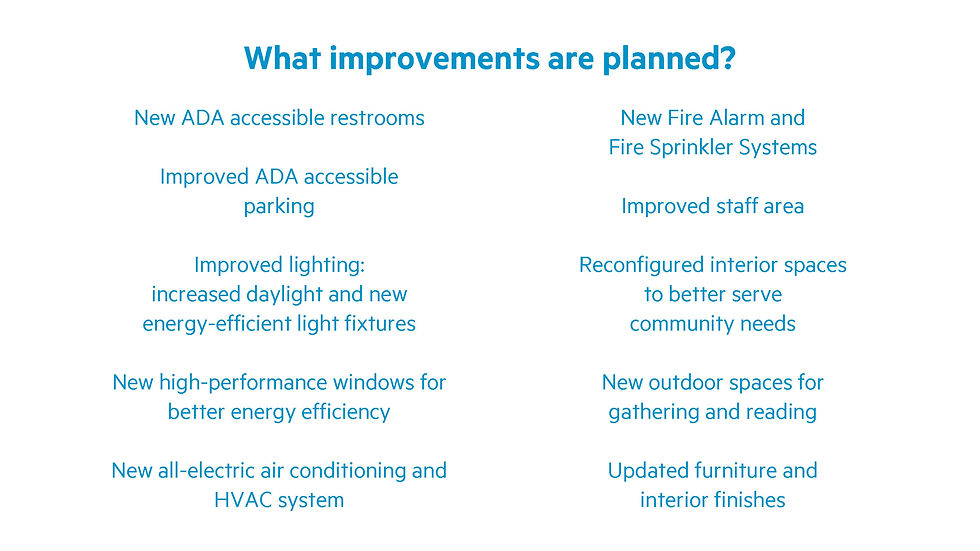
Supervisor Gioia said on July 2 that $5.3 million in funding from the Measure X county sales tax and county library reserves is being used for a major renovation that balances the needs of a broad range of library users including children, young families, seniors, and people who work from home. He said it must meet all the requirements of the Americans with Disabilities Act (ADA) including new ADA compliant bathrooms along with ADA parking and facility improvements.

‘A Long Time Coming’
“This has been such a long time coming and I’m just so excited for the community of Kensington,” County Librarian Alison McKee said. “This is funded partly by Measure X sales tax dollars and also library reserve funding. This is being done with no extra taxes on the community.”
Any plan for renovating the 60-year-old library is limited by the library’s current footprint of 5,000 square feet, the architects said, except that they plan to add a new outdoor reading space by building an enclosed deck at the south end of the building.
Improving Library Access
A major factor driving the design is the goal of improving library access for people with mobility issues and complying with all aspects of the Americans with Disabilities Act (ADA).
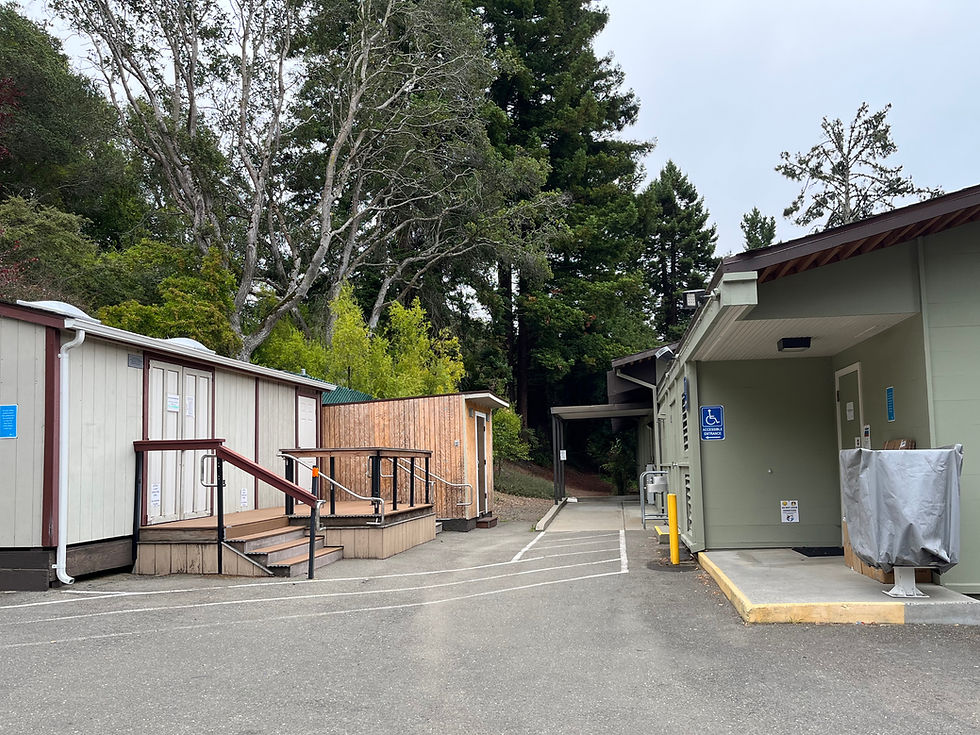
Rather than trying to reconstruct the main entrance to the building, the renovation will improve an entrance from the back parking lot that is currently used only by staff. To comply with ADA, this will require changing the slope of the parking lot and its configuration.
Book Sheds Must Move
Several directors of Friends of the Kensington Library said that, unfortunately, the plan will also require that the Friends remove the sheds in the parking lot where they store and sort donated books for community book sales. There is no new location for the sheds and, for now, the Friends have stopped accepting book donations.
In addition, the architects said, the county’s permitting department has determined that the sheds must be made ADA-accessible.
Cathy Travlos, president of the Friends of the Kensington Library, said her fellow board members are excited about the renovation, but worried about what it will take to find a new place for book storage sheds and keep the sales going.
No Library Book Sales Until Reopening
“We won’t be doing any more sales until the library reopens,” Travlos said.
The sales raise about $8,000 a year which is used to support library programs.
“It’s not huge when you’re looking at budgets countywide, but still significant when it comes to funding library activities,” Travlos said.
She added that the sales attract people to the library and are the group’s main opportunity for personal interactions with community members. Through the years, the Friends have funded many programs. They have also accumulated approximately $150,000.
Several members of the Friends told Livable El Cerrito said the county librarian is a strong supporter of their group.
McKee Says Talks Will Continue
County Librarian McKee said she is talking with the Friends and will continue as long as needed to find a solution to the book shed problem.
“We rely so heavily on the Friends,” McKee said. “The money they bring in supports programs that we would not be able to offer otherwise.”
She said the county has not asked the Friends to help fund the renovation, but any contribution would be appreciated.
Travlos said the Friends were hoping to choose a project that supports the renovation, but that may depend on how much it costs to set up the book sheds in a new location.
She added that individual Friends directors have various questions and concerns, but the group has long supported a library remodel.
“We support the renovation 100%,” Travlos said. “We’re excited about it -- the seismic work, new carpeting, bigger windows. It’s going to be lovely.”
Achieving Better Access
Comparing photos of the front and back entrances at the existing Kensington library shows why access for people with mobility issues could be more easily addressed with an entrance from the rear parking lot.

Adding An Exterior Deck
The conceptual plan shows an exterior deck added to the south end of the library building. It would provide about 600 square feet of extra reading space. Large windows would tie the interior to the exterior.
While at least one critic questioned whether the deck would create an “attractive nuisance” where librarians could not see people, McKee noted that a librarian is assigned to “rove” the library during the busy period immediately after school.

Shelves on Wheels
Some questions were posed about visibility from the staff desk based on the conceptual drawing of book shelves shown below. A project architect said shelves would probably be on wheels so they could be moved as needed. The conceptual drawing does not necessarily show how shelves would be placed.

Flexible Space for Up to 100
Architect Katie Stuart said the design would allow librarians to create a flexible space for up to 100 people to accommodate audiences for programs like Storytime.

Eliminate the Community Room
Travlos said one disappointment about the plan is its elimination of the community room.
Project architects explained that code compliance requires them to add an ADA restroom for staff and another ADA restroom for the public. That meant the staff area, which was already small, had to be redesigned. This conceptual floor plan shows how that was accomplished.
McKee said observations and available data showed the 400-square-foot community room “was empty the vast majority of the time,” so it had lower priority in a design where “every inch is precious.”

Should There Be Pods?
The conceptual designs showed two types of pods that could be used by one person or a very small meeting. McKee said enclosed small meeting rooms are popular at other libraries. Working within the space constraint of the Kensington library, architects tried out the ‘pod’ idea. McKee said that, so far, feedback on whether pods should be included has been about 50-50. The county is currently evaluating whether or not to include pods in the final design.

Focus On County-Owned Libraries
Gioia said the Kensington remodel is one of four county library projects being funded with $14.9 million from diverse funding sources, including revenue from Measure X, which passed in 2020, county library funds, a California State Library Building Forward grant and Bay Area Air Quality Management District Clean Air Center funds. The others are county-owned libraries in Pinole, Antioch, and Ygnacio Valley in Walnut Creek.
“Our capital funding has gone to libraries that we own,” Gioia said.
Gioia said a one-time allocation of $6.5 million in Measure X funds for upgrades to the four libraries was made by the Board of Supervisors four years ago. It was used to leverage about $8.4 million in other funds (including non-county funds).
He added that the county is negotiating with the cities of Pinole, Antioch, and Walnut Creek about transferring ownership of county owned library buildings in those cities once they are updated. The cities would then be responsible for maintaining the buildings while the county continues to fund library staffing and operations for 40 hours per wek, he said.
Kensington is an unincorporated community in the county so its library ownership will not change.


Once again, thanks so much for a truly informative article. The Kensington library is a jewel for the community & will obviously be even more wonderful once all the renovation is done. It is hoped that it can be finished earlier than scheduled, as it will certainly be missed.
Of course, as an EC resident, I was left wondering how our library could be so disadvantaged by comparison. Because of your article, I think I am figuring it out a bit. The EC library is owned by the city, rather than the county. Does that mean that Measure X funds are not available to El Cerrito?
Many of us are hoping that a plan that's better than Measure C can…
Congratulations to the City of Kensington for taking their existing library and giving it a thoughtful, modern update and design created by Noll & Tam. I look forward to visiting once it's complete. Bravo! 👏🏼
So happy for the folks in Kensington and the plan for a new library that meets all their major needs, without adding a tax burden on the residents! I hope they can find a solution for the storage and sale of donated books!